
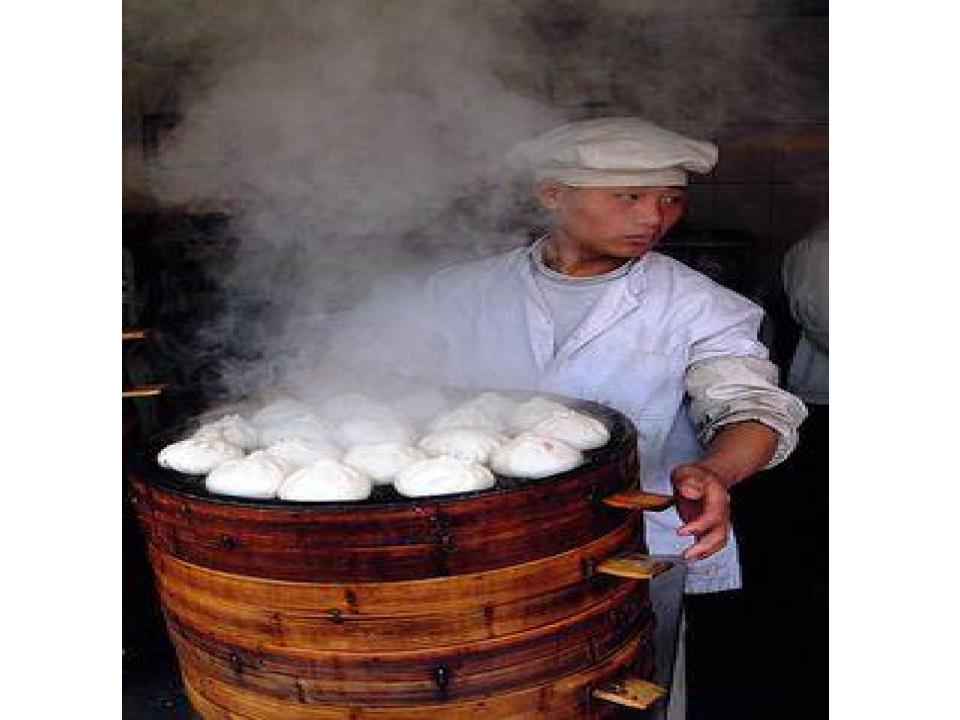
” is a type of cloud-like shaped steamed bread or bun popular in Northern China. Folk etymology connects the name mantou to a tale about Zhuge Liang. (celebrated adviser to Liu Bei, founder of the Shu-Han dynasty). “

Description
“Mantou are soft and fluffy steamed bread mounds, typically eaten as a staple food in northern parts of China where wheat, rather than rice, is grown. They are made with wheat flour, water and a leavening agent-often yeast. Traditionally, mantou is a staple carbohydrate of the northern Chinese diet, analogous to rice, which forms the mainstay of the southern Chinese diet. They are also known in the south of China, but are often served as street food or a restaurant dish, rather than as a staple.”
“Restaurant mantou are often smaller and more delicate and can be deep fried as a dessert and dipped in sweetened condensed milk. A similar food, but with a savory or sweet filling, is baozi. Mantou is the older word, and in some regions (such as the Jiangnan region of China, and Korea) mantou can be used to indicate both the filled and unfilled buns, while in Japan the equivalent local reading of the word (manjū) refers only to filled buns. “
Etymology and history
“Mantou may have originated in the Qin State of the Zhou Dynasty during the reign of King Zhaoxiang (307 BCE – 250 BCE). It as well as other wheat derived foodstuffs such as noodles, Shaobing and Baozi became popular during the Han Dynasty (206 BCE – 206 CE) and collectively were known as 餅; bǐng; mantou was distinguished as 蒸餅; zhēngbǐng or 籠餅; lóngbǐng during the Western Jin Dynasty (265–316 CE).
Shu Xi (束皙) wrote about steamed cakes (蒸餅; zhēngbǐng) in his “Ode to boiled cakes” (湯餅賦; tāngbǐngfù), written around 300 CE. He first called them mantou (曼頭; màntóu). In this book, it was advised to eat mantou in a banquet during the approaching spring.
The Mongols are thought to have taken the filled (baozi) to many countries of Central and East Asia about the beginning of the Yuan Dynasty in the 13th century. The name mantou is cognate to manty and mantı; filled dumplings in Turkish, Persian, Uzbek, and Pakistani (“mantu”)cuisines. In Japan, manjū (饅頭) filled buns, traditionally contain bean paste or minced meat-vegetable mixtures called (nikuman 肉まん “meat manjū”).
Filled mantou are called siyopaw in the Philippines, derived from Chinese shāobāo (燒包). In Thailand, filled mantou is called “salapao” (ซาลาเปา). In Korea, mandu (만두; 饅頭) can refer to both baozi or jiaozi (餃子), and in Mongolian cuisine, manty or mantu are steamed dumplings, which are said to have led to the Korean mandu. In Singapore, the dish chilli crab is commonly served with fried mantou.”
Folklore
“In popular Chinese legend the name mantou literally means “barbarian’s head”. The legend is set in the Three Kingdoms period (220–280 CE) when Zhuge Liang, the Chancellor of the state of Shu Han, led the Shu army on a campaign against Nanman forces in the southern lands of Shu, which correspond to roughly present-day Yunnan, China, and northern Myanmar.
After subduing the Nanman king Meng Huo, Zhuge Liang led the army back to Shu, but met a swift-flowing river which defied all attempts to cross it. A barbarian lord informed him that in olden days, the barbarians would sacrifice 50 men and throw their heads into the river to appease the river deity and allow them to cross.
As Zhuge Liang did not want to cause any more of his men to die, he ordered his men to slaughter livestock and fill their meat into buns shaped roughly like human heads (round with a flat base). The buns were then thrown into the river. After a successful crossing, he named the bun “barbarian’s head” (mántóu, 蠻頭, which evolved into the modern 饅頭).
Another version of the story relates back to Zhuge Liang’s southern campaign when he instructed that his soldiers who had fallen sick from diarrhea and other illnesses in the swampy region be fed with steamed buns with meat or sweet fillings.
References
https://en.wikipedia.org/wiki/Mantou
Personal Note: During a recent trip to China, while living in a resort town in Zhejiang Province, on the second floor of my apartment was market. Several stalls had bakers and cooks preparing take out food. One of my favorite quick morning breakfast dishes was mian bao with red pepper chutney and green tea matcha. Try these warmed and fresh from the streamer.
Recipe:
https://www.mydiversekitchen.com/recipe/we-knead-to-bake-29-tingmos-recipe
My Diverse kitchen-We Knead To Bake #29 : Tingmos/ Ting Momos – Tibetan Steamed Buns With Tomato Based Sepen Hot Sauce/ Chutney
 FOOD FROM ABROAD