
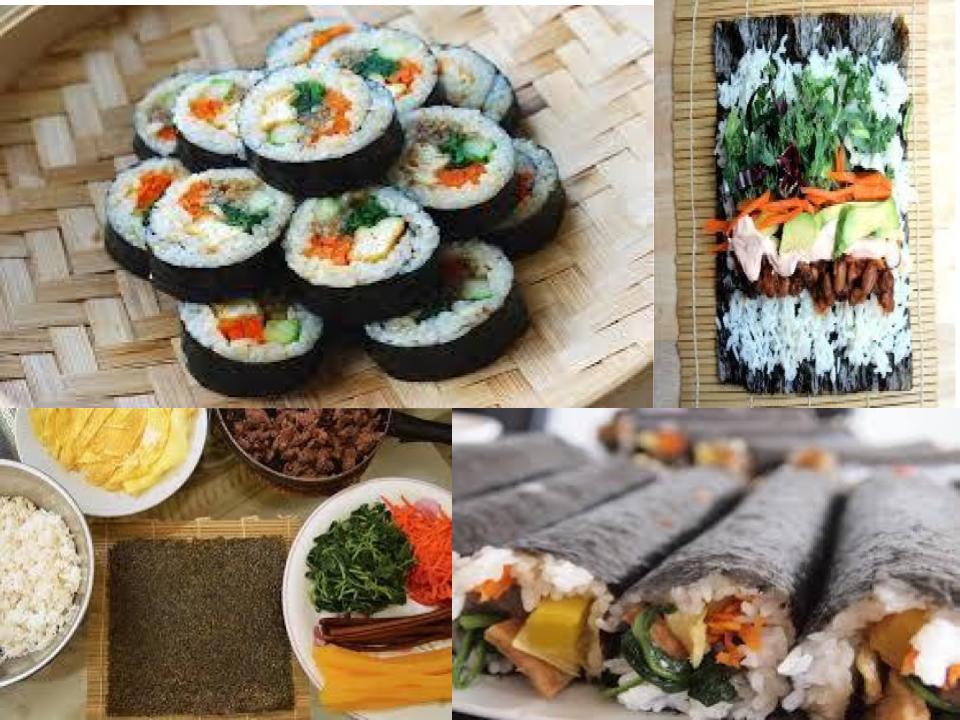
With Kpop idols all the rage these days, all things Korean as well as Korean cuisine is now considered hip. Kim- seaweed, and bapp- rice, or Kimbapp is a favored lunchtime street fare snack commonly called korean sushi. It’s generally larger than a sushi roll and filled or more likely stuffed with vegetables alone or with egg and/or meat /fish or cheese, wrapped in rice surrounded by a nori wrap or seaweed sheet. Like sushi, it is often made with a bamboo sushi wrapper and sliced into rounds. I like to eat it dripped in soy sauce with wasabi, but Koreans generally eat it freshly made and by itself. The trick seems to be to not bite the Kimbapp rounds, but place an entire one it your mouth all at once and enjoy the blending of favors.
“Kimbapp, “is often part of a packed meal, or dosirak, to be eaten at picnics and outdoor events, and can serve as a light lunch along with danmuji (yellow pickled radish) and kimchi.. .It is a popular take-out food in South Korea and abroad, and is known as a convenient food because of its portability. It is usually well wrapped (traditionally with aluminium-foil, but now sometimes in paper)”.
“Etymology- The term gimbap was used in a 1935 Korean newspaper article, but at the time, the loanword norimaki was used as well. Norimaki, which borrowed from the name of a similar Japanese dish, was part of the Japanese vocabulary that entered into the Korean language during the Japanese occupation (1910–1945), when teaching and speaking Korean were prohibited. The two words were used interchangeably until gimbap was made the universal term as part of efforts to clear away the remnants of Japanese colonialism and purify the Korean language.”
“History -Production of gim in Gyeongsang and Jeolla Provinces is reported in books from the 15th century, such as Gyeongsang-do Jiriji and Sinjeung Dongguk Yeoji Seungnam] Eating cooked rice rolled in gim is also a long-standing Korean custom. Yeoryang Sesigi, a Joseon book from 1819, describes a dish called bokssam (복쌈; transcribed using the hanja 縛占, pronounced bakjeom in Korean). There are two conflicting versions of the origin of the modern form of gimbap. Some sources say it was derived from norimaki, a Japanese sushi variant introduced to Korea during the Japanese occupation. Other sources say the food was developed from the local tradition of rolling bap (cooked rice) and banchan (side dishes) in gim. Gimbap and norimaki now refer to distinct dishes in Japan and Korea: the former called kimupapu (キムパプ) in Japanese and the latter called gimchobap (김초밥; “gim sushi”) or norimaki (노리마키) in Korean.
“Gimbap usually contains more ingredients and is seasoned with sesame oil, while norimaki is rolled with fewer ingredients and is seasoned with rice vinegar. “
“Variants Chungmu-gimbap •Chungmu-gimbap (충무김밥) – Originating from the seaside city of Chungmu (currently Tongyeong), the dish features thinner rolls with an unseasoned surface and only rice as the filler ingredient. It is served with spicy ojingeo-muchim (squid salad) and seokbakji (radish kimchi). •Mayak-gimbap (마약김밥) – A specialty of Gwangjang Market in Seoul. Mayak translates as “drug”, a reference to its allegedly addictive and concentrated flavour. Small kimbap filled with carrots, spinach, and danmuji(yellow pickled radish) is sprinkled with ground sesame seeds and dipped in its pairing sauce made from soy sauce and mustard. •Samgak-gimbap (삼각김밥) – Literally “triangle gimbap”. This variety is similar to Japanese onigiri, and is sold in convenience stores in South Korea. Fillings vary greatly. The expiration date is 1 day, and has a calorific value of between 140 and 200 kilo calories usually. •nude gimbap – Unlike ordinary gimbap, the ingredients of the gimbap go inwards, and the rice comes out and covers the entire area. It is similar to Japanese style rolls, but uses ingredients used in Korean-style kimbap (hams, meat fillets, pickled radish, spinach, etc.) and is also served with cheese or sauce.”
 FOOD FROM ABROAD