
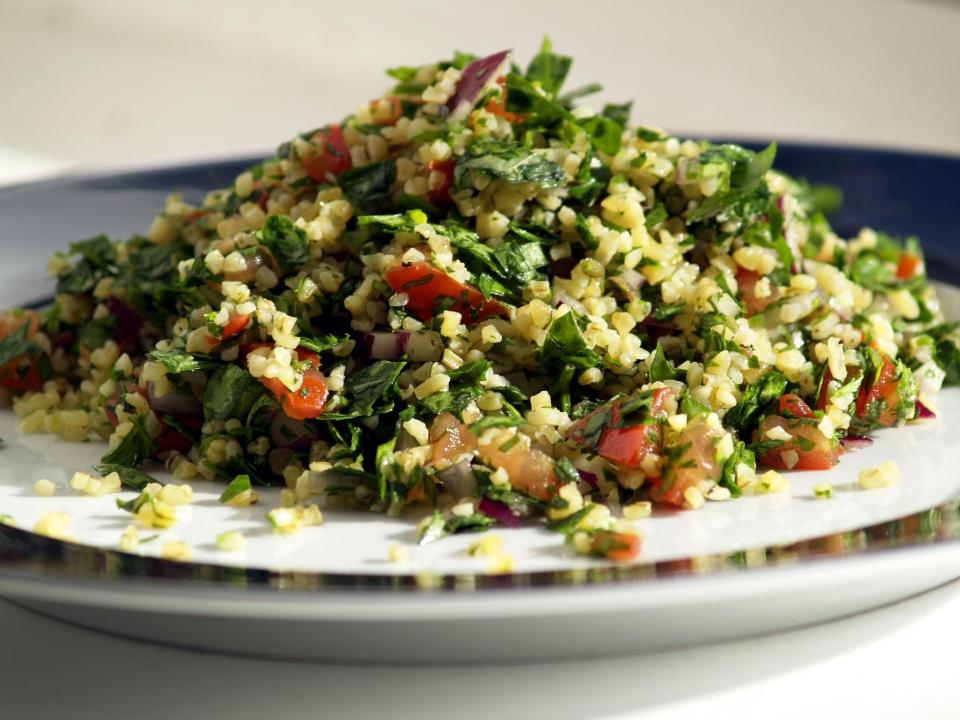
“Tabbouleh (Arabic: تبولة tabūla; also tabouleh, tabbouli, tabouli, or taboulah) is a Levantine vegetarian salad made mostly of finely chopped parsley, with tomatoes, mint, onion, bulgur (soaked, not cooked), and seasoned with olive oil, lemon juice, salt and pepper. Some variations add garlic or lettuce, or use couscous instead of bulgur. . .”
Etymology
“The Levantine Arabic tabbūle is derived from the Arabic word tābil, meaning “seasoning” or more literally “dip”. Use of the word in English first appeared in the 1950s. . .”
History
“Edible herbs known as qaḍb formed an essential part of the Arab diet in the Middle Ages. . .Originally from the mountains between Syria and Lebanon, tabbouleh has become one of the most popular salads in the [region.] The wheat variety salamouni cultivated in Syria, Beqaa Valley and Baalbek was considered (in the mid-19th century) [] particularly well-suited for making bulgur, a basic ingredient of tabbouleh.”
Regional variations
“In the Middle East, particularly Syria, Lebanon, Palestine, Israel, Jordan, Egypt, and Iraq, it is usually served as part of a meze. The Syrian and the Lebanese use more parsley than bulgur wheat in their dish. A Turkish variation of the dish known as kısır, and a similar Armenian dish known as eetch use[s] far more bulgur than parsley. Another ancient variant is called terchots. In Cyprus, where the dish was introduced by the Syrians, it is known as tambouli. In the Dominican Republic, a local version introduced by Syrian and Lebanese immigrants is called Tipile. In Iran and South Asia it is usually eaten with rice, bread and kebabs.”
 FOOD FROM ABROAD